

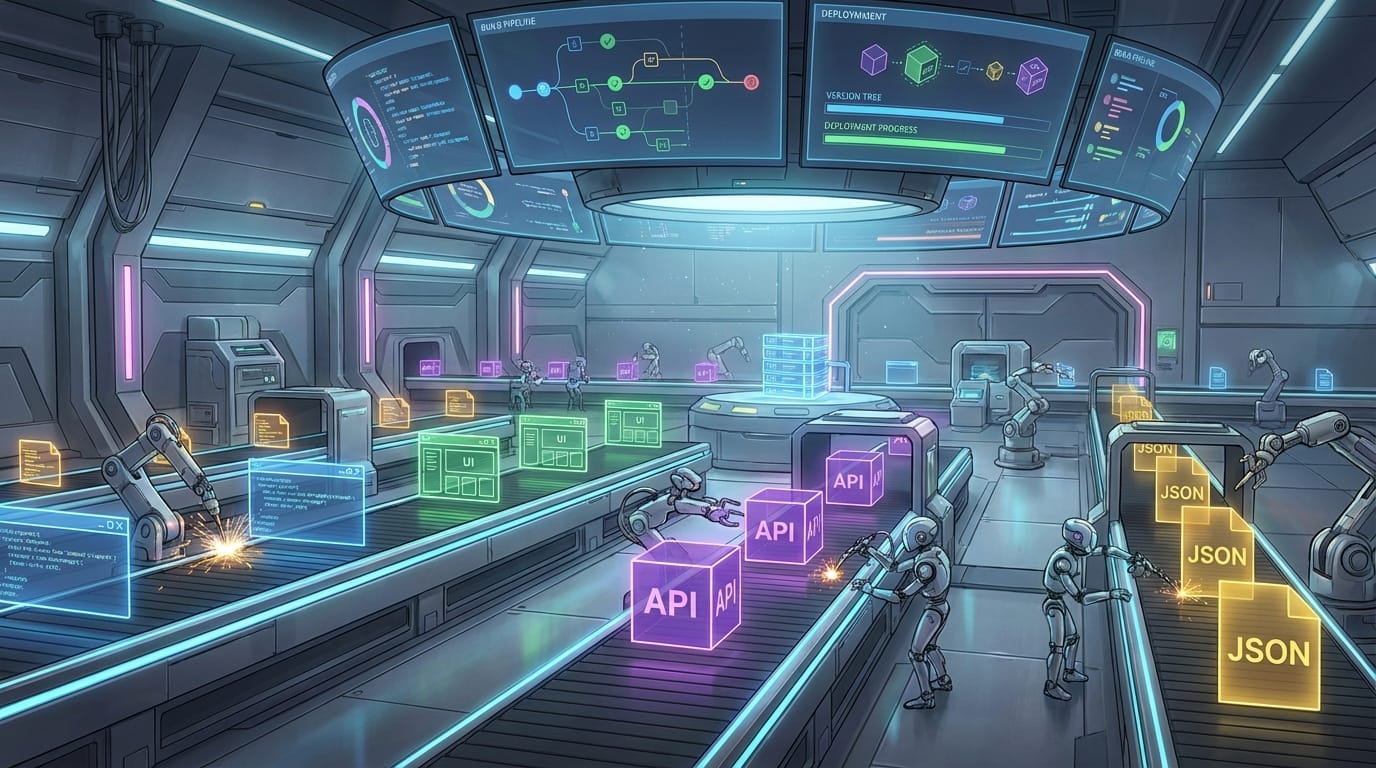
For the first time a solo developer does not need a big team, a custom platform group, or months of internal tooling work to build a serious software delivery system.
You can bootstrap your own self hosted platform now.
Not because infrastructure suddenly got simple, and not because AI magically removes engineering discipline, but because modern coding agents make the hard parts of bootstrapping much easier. They can help you write the docs, shape the repo contracts, generate the scripts, wire up CI/CD, clean up infrastructure code, and keep pushing work forward while you focus on the real bottlenecks.
That is the shift.
You no longer need to design a giant “AI-native development platform” before you get value. You can start with one agent, one terminal, one control repo, and one real application. From there, the agent helps you build the very system it will later operate inside.
That is what makes this pattern so powerful: it is not heavy. It is not reserved for large teams. There is no vendor lock in who vision isn’t aligned. It is an agent-first way for a single developer to stand up a practical, self-hosted software factory without drowning in platform work first. The entire system is portable and customizable to your beliefs.
The goal is not to build the perfect system on day one. The goal is to get unblocked, get a working foundation in place, and let AI help you bootstrap the rest.
What a personal software factory actually is
A personal software factory is a text-defined, terminal-operated, self-hosted software delivery system. In the model I recommend, code and markdown are the source of truth, GitLab is the control plane, the terminal is the execution surface, Terraform defines infrastructure with Cloudflare as traffic control, a secret manager handles credentials, and coding agent(s) like Codex or Claude Code acts as the worker inside the system.
That sounds bigger than it is.
At the start, you do not need a giant platform team setup. You do not need a fleet of specialist agents. You do not need a custom web dashboard. You do not need to sandbox everything from day one. You do not need a perfect project-management layer on day one.
What you need is a setup where:
the agent can read the repo, docs, and scripts
the agent can work in a terminal you control
the control plane validates and ships the real changes
important actions leave evidence
production is gated by policy, not vibes
That is enough to get started. We are building the platform to ship code.
The mistake people make
The most common mistake is overbuilding the control system before unblocking the work.
People jump straight to questions like:
Should I have planner agents, reviewer agents, QA agents, and release agents?
Do I need containers, VMs, and ephemeral runners everywhere?
Should I build a custom orchestration dashboard?
Do I need perfect observability before the first agent session?
Those are later questions.
Your first goal is much simpler:
Get one capable coding agent doing real work inside a controlled, text-defined workflow.
That is the bootstrapping problem.
Start with one agent type, not a zoo
One of the strongest ideas in the factory model is the single-agent-first approach. One primary coding agent type should be enough to plan, implement, review, run local checks, prepare merge requests, and follow the release path through the control plane. Specialized agents may be useful later for scale or isolation, but they are not the starting requirement.
This matters because most early AI workflows fail from unnecessary complexity, not lack of sophistication.
If one agent can:
read your issue
inspect your docs
modify code
run local checks
open an MR
respond to CI results
update a runbook
Then you already have something valuable.
Your first version should be terminal-first and boring
You do not need a fancy runtime to begin.
A practical v1 looks like this:
the human runs the coding agent in a terminal
that terminal is on a trusted laptop or trusted SSH-accessible host
the scope is the repo, worktree, Unix user, host network reach, and documented policy
repo state and host caches can persist
durable knowledge lives in repos, docs, CI artifacts, and runbooks, not the model’s memory
skills that make agentic use easier
That host-shell-first model is not a compromise. It is the easiest setup to supervise, debug, and improve.
A lot of people try to begin with hard sandboxing, clean-room runners, custom dashboards, and multi-agent orchestration. That is usually premature. The first milestone is not “perfect isolation.” The first milestone is “the agent can actually help me ship.” The vision of your factory will become clearer as you take more action, and then you can tailor it to your needs.
Make the control plane authoritative
This is the most important design decision.
Let the agent iterate locally. Let it run tests. Let it inspect logs. Let it draft infrastructure changes. But do not treat the terminal session as the source of truth.
The control plane should own the authoritative workflow:
build and deployment pipelines
CI validation
protected branch rules
approvals
infrastructure plan/apply
quality control gates
release flow
audit evidence
In practice, that means:
“local checks passed” is helpful, but not sufficient
“the agent says it’s ready” is not enough
“GitLab pipeline passed all verification jobs and the environment gate approved” is what counts
This is where a lot of agent setups go off the rails. They trust the local session too much and the system too little. The agent builds and operates the factory. The factory controls what can actually be shipped out.
The specification below will be your definitive guide.
